
Environments and species
Potential of the Nouvelle-Aquitaine region
A faunal richness to discover
In the absence of major specialised research centres within the region, stygofauna in Nouvelle-Aquitaine was studied only on very rare occasions before our programme was established.
Consequently, there is now a very large disparity in knowledge of these species between departments.
Thus, in 2020, Pyrénées-Atlantiques had 56 identified taxa, 46% of which are endemic, across 90 sites studied, whereas 6 taxa were identified in Gironde across 26 sites studied.
The small size of the species studied, the complexity of their identification, and the difficulties of accessing the environments that host them are all factors that may explain the current lack of knowledge surrounding stygofauna.
Nevertheless, a preliminary analysis of the PASCALIS database (Protocols for the Assessment and Conservation of Aquatic Life In the Subsurface) revealed that south-western France was the second richest area in terms of taxonomic diversity.
The Nouvelle-Aquitaine region therefore has significant potential for stygobiotic species.
In addition, through the number and type of sites surveyed, the study programme will make it possible to determine whether the scarcity of observation data in certain departments, such as Creuse or Haute-Vienne, results from a historical lack of sampling or from a genuine paucity of stygobiotic taxa (unsuitable or uncolonised habitats).
A unique territory
If the potential for discovering stygobiotic species is so high, it is due to the distinctive profile of the Nouvelle-Aquitaine region from a hydrological, geological and hydrogeological perspective.
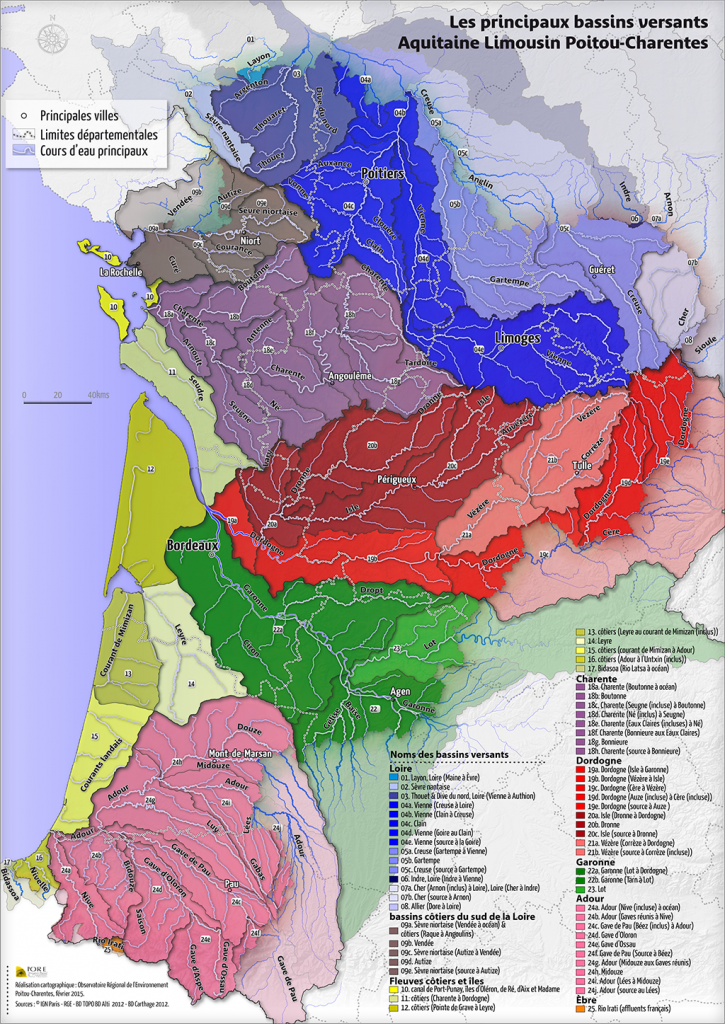
First, the Nouvelle-Aquitaine region is divided between two major river basins: the Adour-Garonne basin (71% of the territory) and the Loire-Bretagne basin (29%), each of which is then subdivided into several catchments.
This configuration provides the Aquitaine territory with a great diversity of aquatic environments and associated ecosystems, essential components of the water cycle: headwaters with extensive networks of small watercourses, streams, rivers, major rivers, ponds and wetlands, estuaries and coastal waters, shallow or deep groundwater aquifers.
All of these environments are likely to support a diverse biodiversity.
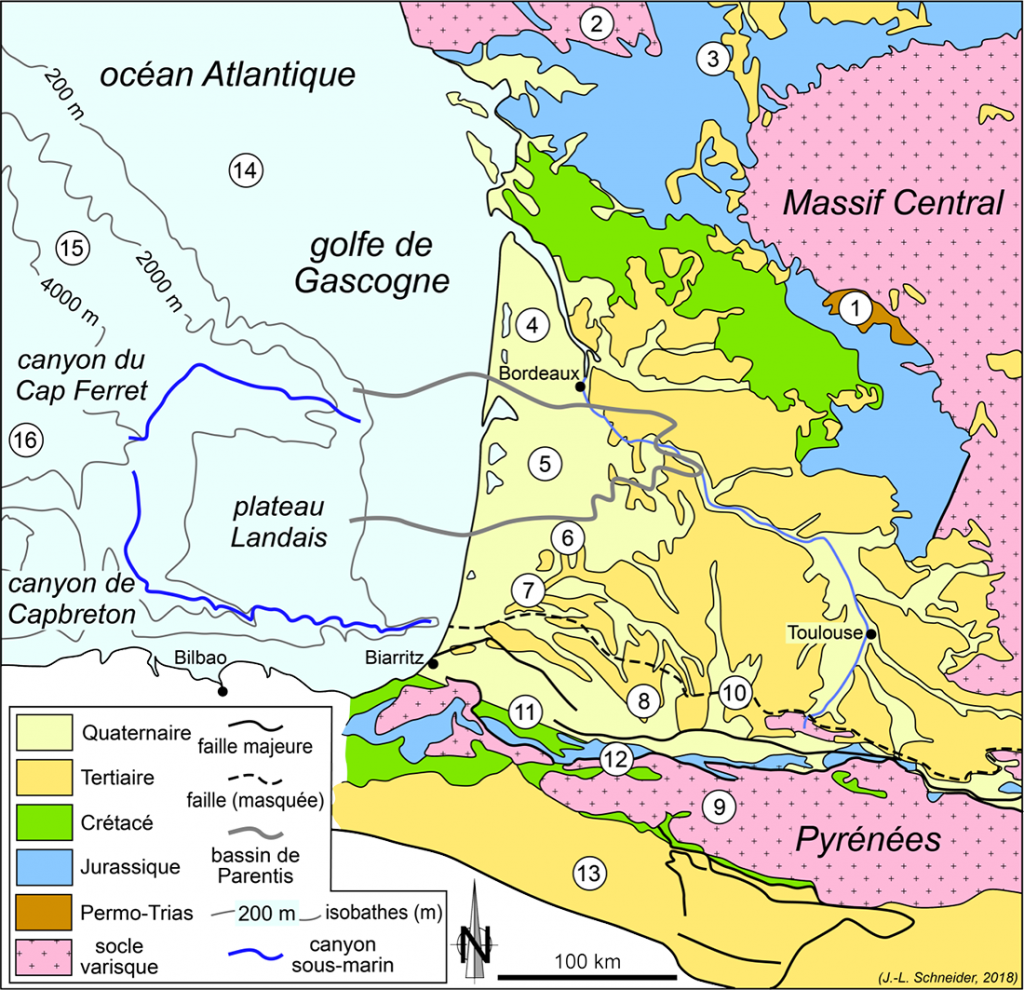
From a geological perspective, the Region is divided into three major domains whose history and structure influence how water circulates and is stored today:
- the sedimentary domain (Paris Basin and Aquitaine Basin),
- the basement domain (Massif Central and Armorican Massif), and
- the Pyrenean domain.
The geological diversity of the terrains that make up this vast territory results in a wide variety of regions, landscapes and landforms, bearing witness to a history spanning 540 million years.
With regard to groundwater, the varied geological contexts present in Nouvelle-Aquitaine determine the geographical distribution, availability and vulnerability of groundwater resources across the region.
In which environments does stygofauna thrive?
Given the biology of the species considered, only unconfined groundwater bodies, connected to the ground surface, provide subterranean aquatic fauna with living conditions that allow it to develop (inputs of organic matter, dissolved oxygen content, etc.).


